

Soms heb je van die problemen waar je lang naar zoekt, maar waar je eigenlijk geen tevredenstellende oplossing voor kunt vinden. Zo ook de roetfilterproblemen bij deze voertuigen. In mijn carrière als diagnosespecialist heb ik deze voertuigen meer dan eens zien langs komen met de klacht:
“My display says 'Check Injection System' and 'Check Air Pollution' “.
In addition to this visual cry for help from the engine management, the vehicle is also unable to move forward due to the associated emergency run.
Very often the codes below then come up:
DTC253F29 / P253F Engine Oil Dilution / Smeerolieverdunning
DTC200292 / P2002 Particulate Filter Clogged.
P119F:22 / P119F / Engine Oil Dilution Value Above Setting
In a nutshell, P2002 is a result of P253F, at least if driven too long. Just a bit of DPF theory to better understand the origin of these codes:
Once the soot level in the DPF exceeds a certain threshold, the engine management responds by initiating regeneration. This is accomplished in most systems by injecting a small amount of fuel during the exhaust stroke. This causes the exhaust gas temperature to rise to between 550 and 650 degrees, resulting in the combustion of soot particles.
Because the injection occurs during the exhaust stroke, there is no combustion pressure in the cylinders at that time. Due to the lack of combustion pressure, the piston rings do not seal quite nicely, causing some of this injected fuel to leak past the piston rings. This eventually ends up in the engine oil, slowly but surely saturating it with diesel: Lube oil dilution.
Older engine management systems did not take this into account, with the result that when the regeneration frequency was too high, the oil level rose to such an extent that the engine began sucking its own oil through the crankcase vent and, in some cases, went haywire. In most cases, this meant a new engine for the customer.
More modern engine management systems keep an eye on things themselves. The percentage of lube oil dilution (which you can usually read with your diagnostic tester) is always a calculated (modeled) value, since it is not possible to physically measure saturation. The value is calculated using a so-called model. This model is integrated into the software of the control unit. In it, various measurement values are used, including regeneration duration, amount of fuel injected during regeneration, various temperatures and miles driven in order to then calculate a certain percentage of lube oil dilution.
Above a certain percentage of lube oil dilution, the engine management blocks regeneration of the particulate filter and stores error code P253F. If this is continued, the particulate filter becomes increasingly clogged until, at a certain threshold, error P2002 is stored.
So: Change oil, reset oil quality, perform regeneration and you're done? Right! After that, the lights are out again and the customer can continue his drive again trouble-free. Often this is the solution and we hear nothing more about it. Unfortunately, cars regularly returned with the same complaints. Sometimes already after 5 to 10,000 kilometers, while the service indicator shows that another 30,000 kilometers can be driven until the next oil service.

As the workshop became more frequently plagued with this problem, similarities began to be noticed:
In most cases, the vehicle was used for short runs, or stop & go. 1 of these problem buses was in the fleet of my old employer. The bus was used to deliver parts to garages, in other words a lot of stop & go. With this bus a whole arsenal of solutions were tried: 4 new injectors, new turbos, new egr valve, new original particulate filter and of course a software update of the engine management. You guessed it, none of these measures solved the problem. The only solution to get rid of this problem for good was to physically remove the particulate filter, but especially with the current MOT rules, this is no longer possible.
So, there had to be another solution, obviously while retaining the particulate filter. By doing a lot of measuring and monitoring on the 'prototype', I found out that the calculation of the lube oil dilution on stop & go vehicles is not quite correct, causing the engine management to incorrectly indicate far too early that the oil is saturated, with all its consequences.
Meanwhile, an extensively tested, 100% working solution has been found for this problem. With this, not only the prototype in question is driving around, but by now +/- 50 other vehicles are already driving around, all of which are no longer experiencing any of the above problems.
Voor deze reparatie hebben we in principe het voertuig nodig bij ons in de werkplaats. De duur van de reparatie bedraagt – afhankelijk van de verontreinigingsgraad van het roetfilter – ongeveer 1 a 2 uur. Indien het roetfilter te zeer vervuild om veilig te kunnen regenereren, zullen we het eerst chemisch moeten reinigen. Dit kunnen wij ook voor u uitvoeren.
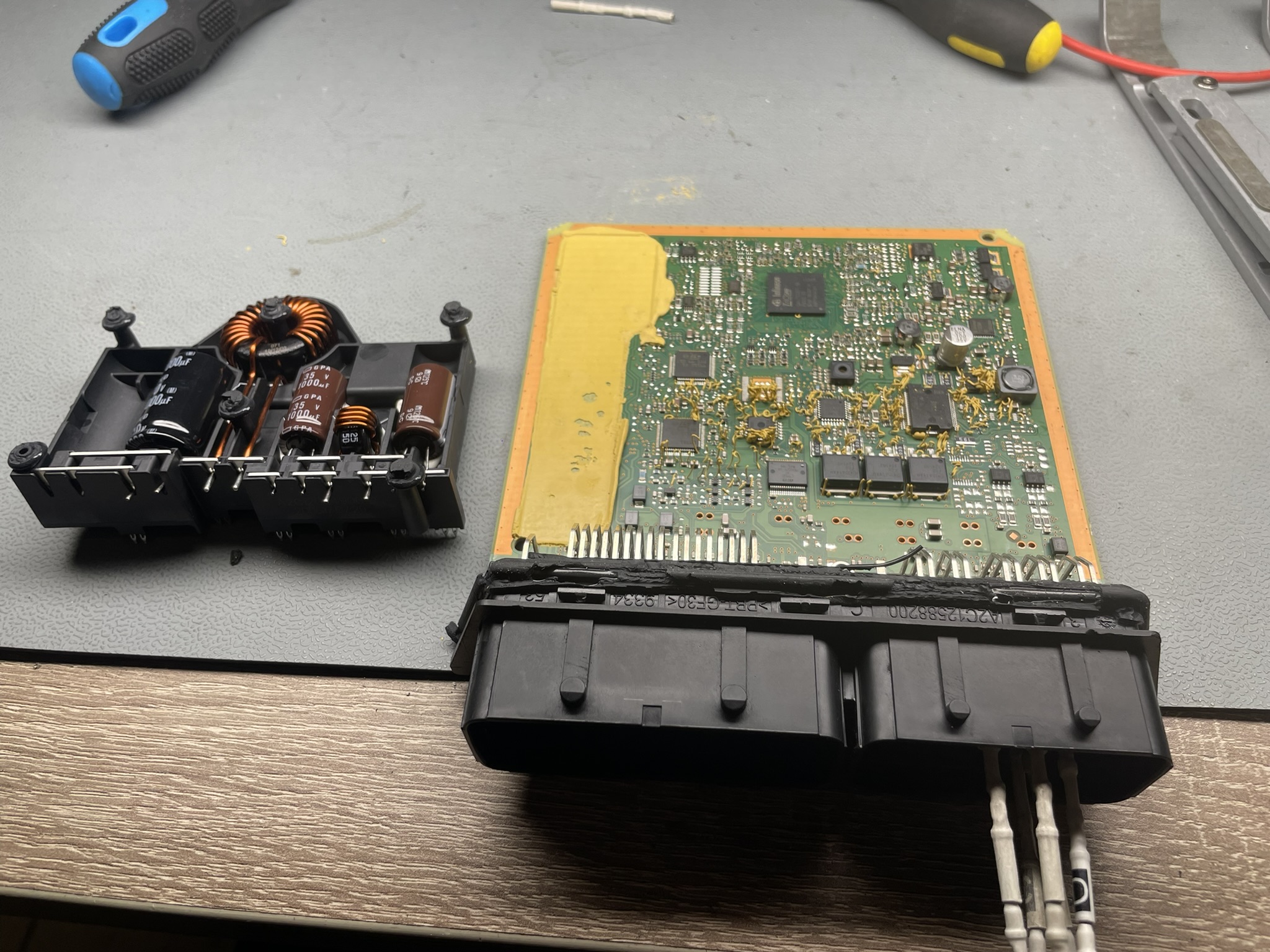
Indien het niet mogelijk is om met de hele bus langs te komen, kunt u ook de motor ecu naar ons toe sturen. Wij repareren deze en sturen hem terug. In dat geval is het wel belangrijk dat u zelf kunt beoordelen of er naderhand een regeneratie of zelfs reiniging van het roetfilter nodig is. Hierover kunt u ons uiteraard ook bellen, dan beoordelen wij telefonisch enkele meetwaarden.
We have already carried out this repair successfully on the following types:
Renault Trafic, Renault Master, Opel Vivaro, Opel Movano, Nissan Interstar, Nissan NV300, Mercedes Benz Vito / V-Klasse. Deze voertuigen zijn uitgerust met onderstaande motorregeleenheden: Bosch EDC17C84 EDC17C42 EDC17C11 EDC16CP33 EDC17C66 MD1CS006 en Siemens SID310
NIEUW: Nu ook mogelijk bij Renault Kangoo / Mercedes Citan uitgerust met Bosch MD1CS006 / MD1CS016 ecu!! Tevens hebben we deze oplossing kant en klaar voor de nieuwste generatie Siemens SID321 uit de Renault Master V / Opel Movano. DCM7.1a en DCM7.1b en de MD1CS069 uit de nieuwste PSA generatie ook klaar!


 English (UK)
  Nederlands
  Deutsch